Why Doing Less Can Sometimes Help Us Achieve More
Modern workplaces often celebrate productivity.
Busy calendars, back-to-back meetings, endless notifications and long to-do lists can easily become markers of success. Yet many people are discovering that working harder is not always leading to better thinking, greater effectiveness or improved wellbeing.
Instead, many professionals are reaching a point where they feel mentally overloaded, emotionally drained and increasingly disconnected from the way they usually work.
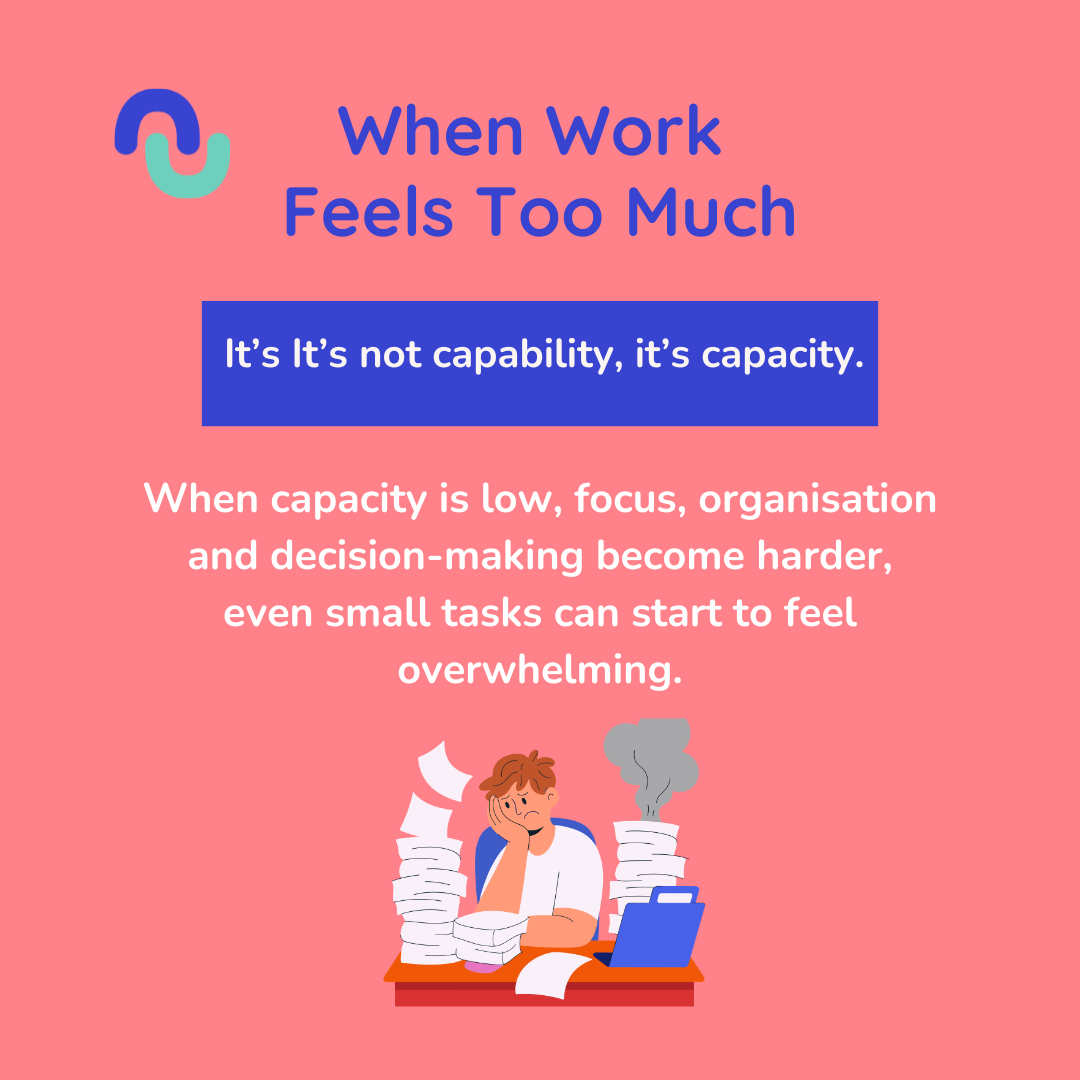
What if the issue is not capability?
What if the issue is capacity?
Understanding cognitive capacity
We all know what it feels like to run on empty.
When stress continues for long periods of time, it becomes harder to focus, organise ourselves, manage competing priorities, regulate emotions, think flexibly and get started on tasks.
These processes are closely linked to executive function — the mental processes that help us manage ourselves in order to achieve goals.
Executive function includes areas such as:
- task initiation
- planning and prioritisation
- organisation
- sustained attention
- working memory
- cognitive flexibility
- emotional regulation
- self-monitoring
When capacity becomes depleted, these skills are often the first things we notice changing.
You may begin to find yourself:
- rereading the same email several times
- struggling to start tasks you know are important
- forgetting details that would usually be easy to remember
- feeling overwhelmed by decisions
- becoming more emotionally reactive
- moving through the day constantly busy but not feeling productive
This is not necessarily a sign of reduced ability.
It may simply be a sign that your brain is working under conditions that make high-level thinking harder.
High performance does not happen under constant pressure
Many workplace cultures unintentionally create environments where people feel they need to operate at maximum output all of the time.
But executive function does not tend to work at its best under sustained pressure.
It relies on certain conditions:
- psychological safety
- recovery time
- meaningful connection
- manageable challenge
- opportunities for autonomy
- realistic expectations
Without these conditions, even highly capable people can begin to struggle.
Capacity building is not the same as productivity
When people feel overwhelmed, the instinct is often to do more:
- create another list
- download another productivity app
- work longer hours
- push harder
But capacity building is different.
Rather than asking:
“How can I fit more in?”
We might ask:
“What helps me function well?”
Capacity grows when we understand the conditions that support our thinking and energy.
Sometimes that means introducing challenge.
Sometimes it means creating space.
Sometimes it means doing less.
Real-life executive function in the workplace
Executive function is not something we use only in formal training sessions or development programmes.
We use it constantly.
For example:
A team member leading a project may be using:
- planning
- prioritisation
- cognitive flexibility
- sustained attention
- emotional regulation
Someone managing multiple deadlines may be relying on:
- working memory
- organisation
- task initiation
- self-monitoring
A manager supporting a difficult conversation may be drawing on:
- inhibition
- emotional regulation
- perspective-taking
- flexibility
When these skills become stretched, performance can appear inconsistent.
The challenge is that workplaces often focus on the visible outcome rather than the processes underneath it.
Instead of asking:
“Why isn’t this person performing?”
We may need to ask:
“What might be affecting their capacity right now?”
Learning how your brain works
Perhaps one of the most valuable things we can develop at work is greater self-understanding.
Different people build capacity in different ways.
Some people function best with predictable structure and routines.
Others thrive on novelty and variety.
Some people need movement breaks.
Others need quiet thinking space.
Some need opportunities for connection.
Others need recovery after intensive social interaction.
Useful questions might include:
- What gives me energy?
- What drains me?
- What helps me get started?
- What helps me maintain focus?
- What support works best for me?
- What helps me recover when I feel overloaded?
These are not small questions.
They are the foundations of sustainable performance.
A final thought
The goal at work is not to function at maximum output every moment of every day.
The goal is to create conditions where people can think clearly, contribute meaningfully and work in ways that are sustainable.
Because understanding how we work is often just as important as understanding what we do.
Sometimes building capacity is not about pushing harder.
Sometimes it starts by creating enough space for our brains to work well.